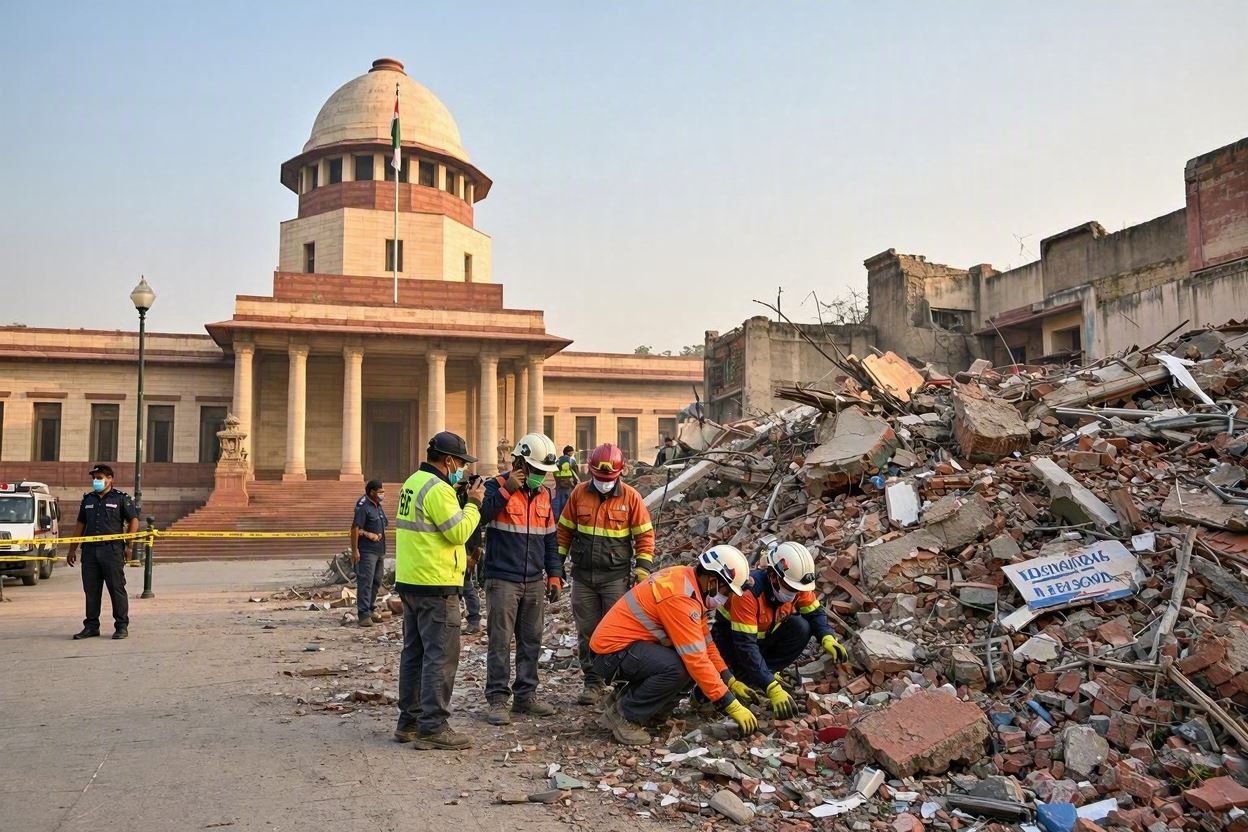
The Supreme Court of India has signaled its intention to examine building safety and unauthorized construction issues on a nationwide basis following the tragic collapse of a student accommodation building in Delhi's Satya Niketan area.
A Bench comprising Justices A. Amanullah and R. Mahadevan observed that the issue extends beyond a single incident and may require comprehensive pan-India guidelines to address systemic failures in building regulation and safety compliance. The Court made the observation while hearing matters connected to illegal constructions and urban safety concerns.
The development follows the collapse of a five-storey building used as student accommodation in Satya Niketan, Delhi, which resulted in multiple fatalities and injuries. The incident has triggered serious concerns regarding structural integrity, unauthorized alterations, municipal oversight, and compliance with building regulations.
During the proceedings, Senior Advocate Ajit Kumar Sinha, acting as amicus curiae, informed the Court that he had filed a status report regarding inspections being conducted by a committee previously constituted by the Supreme Court. The committee has been examining buildings in various parts of Delhi for safety and regulatory compliance.
The Court also took note of an application seeking time-bound inspections and safety audits of paying guest accommodations, private hostels, and student housing facilities across Delhi. The proposal aims to assess structural safety, sanctioned building plans, fire safety measures, land-use compliance, and occupancy conditions.
Solicitor General Tushar Mehta informed the Bench that related proceedings concerning the Satya Niketan collapse are currently pending before the Delhi High Court. However, the Supreme Court indicated that it may transfer the matter to itself to ensure uniform consideration alongside broader nationwide concerns.
The Bench remarked that it already has a framework in mind and that any eventual directions would likely operate on a pan-India basis. The Court is expected to further examine whether nationwide standards, compliance mechanisms, and accountability measures should be established for student housing facilities and buildings susceptible to structural risks.
The case highlights growing judicial scrutiny of unauthorized constructions, regulatory lapses by municipal authorities, and public safety concerns in densely populated urban areas. Any guidelines eventually issued by the Supreme Court could have far-reaching implications for municipal governance, urban planning, building safety audits, and enforcement practices across India.