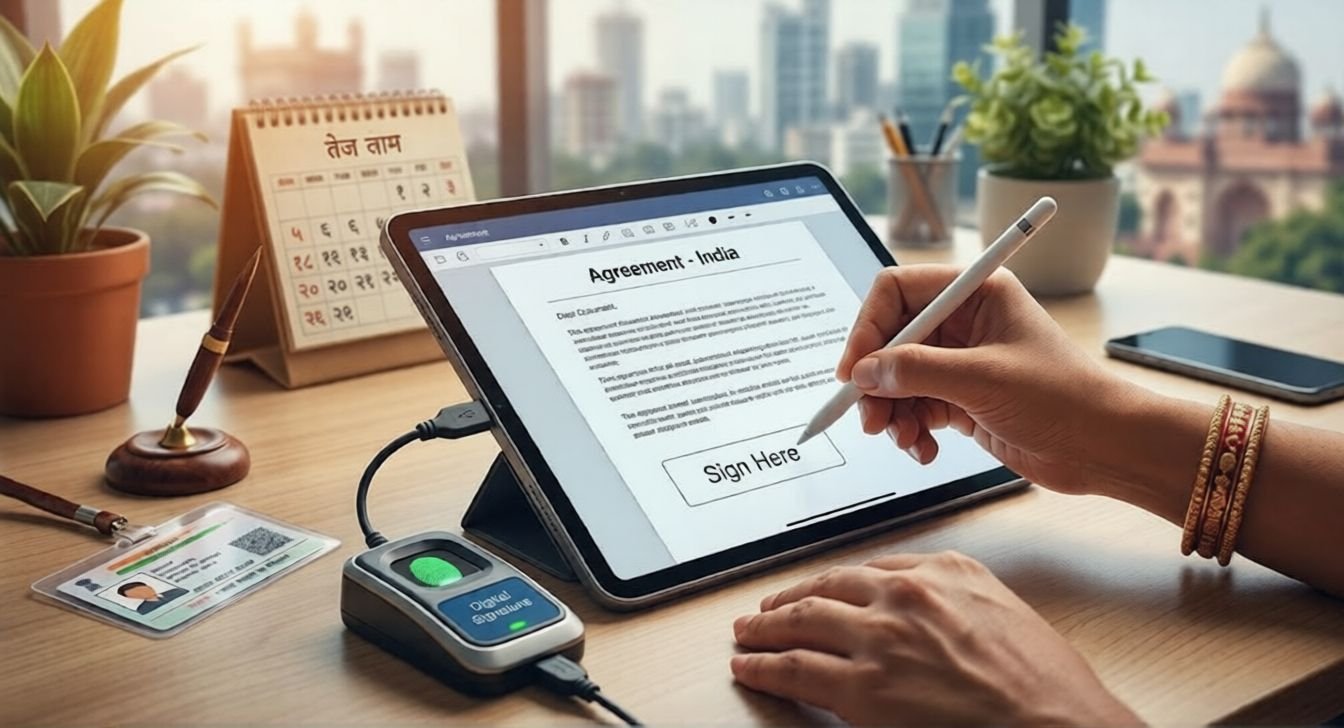
A few years ago, getting a document signed meant printing it out, running a pen across the dotted line, scanning it back in, and emailing it off — or worse, couriering it across the city and waiting. Today, most of us just click a button. That shift happened because of digital signatures, and understanding how they work can save you a surprising amount of time, money, and paperwork headaches.
Whether you're a business owner filing returns, a freelancer trying to get a contract signed without chasing someone for a wet-ink signature, or just someone curious about why your CA keeps asking for your "DSC" — this guide walks through the use of digital signatures in plain, everyday language.
What Is a Digital Signature Certificate (DSC)?
A digital signature isn't the same as scanning your handwritten signature and pasting it onto a PDF. That's just an image — anyone could copy it and stick it on another document. A real digital signature is built on cryptography, and it comes attached to something called a Digital Signature Certificate (DSC).
Think of a DSC as your digital identity card. It's issued by a licensed Certifying Authority (CA) in India — names like eMudhra, Capricorn, and Sify — after they verify who you actually are, usually through your PAN, Aadhaar, and a video verification step. Once issued, the certificate is stored either on a USB token or, for newer options, in the cloud.
When you use this certificate to sign a document, the software creates a unique digital fingerprint of that file and locks it with your private key. If even a single comma in the document changes after signing, the fingerprint no longer matches — and anyone who opens the file will immediately know it's been tampered with. That's the real value: not just signing, but proving that a document is genuine and hasn't been altered.
DSCs generally come in three classes. Class 3 is the only one that matters for most practical purposes now — Class 1 and Class 2 have largely been phased out for regulatory filings. Class 3 certificates are used for everything from income tax filing and GST returns to company registrations on the MCA portal and participating in e-tenders.
Is a Digital Signature Legally Valid in India?
Yes — digital signatures issued by a licensed Certifying Authority carry full legal weight in India.
The Information Technology Act, 2000 is what gives digital signatures their legal standing. Section 5 of the Act specifically states that where a law requires a document to be signed, a digital signature satisfies that requirement, as long as it's affixed in the prescribed manner. This isn't a grey area or workaround — it's built into the law itself.
Indian courts have upheld the validity of digitally signed documents in disputes, and government departments rely on them daily. The Ministry of Corporate Affairs, the Income Tax Department, the GST portal, and various state e-procurement systems all mandate or accept digitally signed submissions.
It's worth drawing a quick distinction here, since the terms get used loosely:
- Electronic signature — the broader term, covering anything from a typed name to a click-to-accept checkbox to an OTP-based confirmation.
- Digital signature — a specific, cryptographically secure type of electronic signature backed by a certificate.
Both have legal recognition under Indian law, but a digital signature offers a stronger level of proof — which is why regulators insist on it for high-stakes filings like company incorporation or tax submissions.
Where Can You Actually Use a Digital Signature?
Corporate and Tax Compliance
Company and business filings are the most common use case. Anyone registering a company, filing annual returns, or submitting forms to the Registrar of Companies needs a DSC. The same applies to GST registration and return filing, income tax e-filing for businesses and certain categories of individual taxpayers, and customs documentation for import-export businesses.
Legal Contracts and Business Agreements
Digital contract signing has become the norm for companies with remote teams and clients spread across cities or countries. Instead of printing an NDA or vendor agreement and mailing it around for wet signatures, businesses now send a link — the other party signs from their laptop or phone in minutes.
Everyday Operations via E-Sign Platforms
Online document signing services let you upload a document, mark where signatures are needed, and send it out. The recipient gets a request notification, opens the link, and signs without downloading any software. Real estate agreements, employment offers, freelance contracts, vendor NDAs — all handled this way now.
For something less formal, most PDF tools and free browser extensions let you draw or type a signature and drop it into a document instantly. It won't carry the same weight as a DSC for legal filings, but for internal approvals or low-stakes paperwork, it's perfectly fine.
There's also the everyday convenience angle: freelancers attaching a certified electronic signature to invoices for authenticity, HR departments signing offer letters digitally before sending, educational institutions issuing digitally signed certificates and transcripts that employers can verify instantly.
How to Get a Digital Signature in India
The process isn't complicated. You fill out an application with a licensed Certifying Authority, upload your identity and address proof, complete a video verification, and receive your certificate within a day or two in most cases.
What used to take a physical visit to a notary and a stack of paperwork can now be wrapped up before your morning coffee gets cold. That's really the story of digital signatures in India — not some dramatic technological leap, but a quiet, practical shift that's made signing things a little less annoying for everyone involved.